Independence Day: Tinubu Marks Anniversary in Lagos, Breaking Abuja Tradition
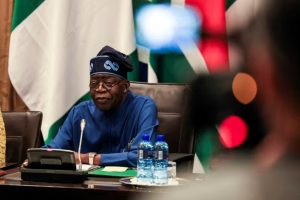
President Bola Ahmed Tinubu has made history by becoming the first Nigerian leader since the relocation of the capital to Abuja to commemorate Independence Day in Lagos instead of the Federal Capital Territory. The unusual move has sparked debate, rekindled memories of Nigeria’s early independence anniversaries, and raised questions about the direction of future national celebrations.
A Historic Break from Tradition
Since October 1, 1960, when the Union Jack was lowered and the Green-White-Green flag hoisted for the first time, Independence Day has been marked as a symbolic occasion of national pride. At the inaugural ceremony in Lagos then the capital Princess Alexandra of Kent, representing Queen Elizabeth II, formally handed over constitutional instruments of independence, while Nnamdi Azikiwe was sworn in as Governor-General and Prime Minister Tafawa Balewa delivered Nigeria’s first independence speech.
Following the relocation of the capital to Abuja in 1991, successive leaders, both civilian and military, have observed the October 1 celebrations there. The events typically feature military parades, cultural displays, and presidential speeches from Eagle Square, reinforcing Abuja’s position as the seat of national power.
This year, however, President Tinubu opted to return to his home state of Lagos, altering a long standing national tradition.
Signs of a Shift
Hints of the unusual plan first emerged on September 26, when Presidential spokesman Bayo Onanuga issued a statement placing Tinubu in Lagos. The itinerary suggested he would be in Imo State on September 30 for an official visit and later commission the remodelled National Theatre renamed the Wole Soyinka Centre for Culture and Creative Arts in Lagos. However, the statement stopped short of clarifying where the Independence Day itself would be observed.
The uncertainty was compounded by the sudden cancellation of the traditional Independence Day parade. No official explanation was provided, leaving room for speculation. The parade, a central feature of the anniversary, has always symbolized the unity of Nigeria’s armed forces and the resilience of its people.
With Vice President Kashim Shettima away in Germany after representing Tinubu at the United Nations General Assembly in New York, the absence of top federal officials in Abuja further confirmed that this year’s commemorations would deviate from the norm.
Speech from Aso Rock, Celebration in Lagos
Although Tinubu’s Independence Day speech, released by his media team, was said to have been delivered from Aso Rock Villa, the broader national mood reflected Lagos as the focal point of activity. By prioritizing project commissioning and cultural events in Lagos, the President appeared to signal a desire to tie the country’s independence story back to its historical roots.
For many, this evoked nostalgia for Nigeria’s formative years when Lagos was the capital and the hub of political and cultural life. Yet, for others, it raised concerns about whether future anniversaries may be shaped more by personal preference than by established national practice.
Symbolism and Reactions
Tinubu’s decision carries strong symbolism. Lagos, his political base and Nigeria’s economic nerve centre, was the birthplace of independence festivities in 1960. Hosting the 65th anniversary there could be seen as a nod to history, while also projecting Lagos’ role in shaping Nigeria’s future.
Still, critics argue that the move undermines Abuja’s status as the neutral centre of national unity. The cancellation of the military parade, in particular, left some Nigerians feeling that the 2025 celebration was incomplete. Others worry that if such decisions become precedent, future leaders might tailor national observances to suit regional or personal considerations.
A New Chapter in Independence Commemorations
Whether viewed as a symbolic reconnection with history or a controversial departure from protocol, Tinubu’s Lagos-centred Independence Day has clearly marked a new chapter in how Nigeria remembers its sovereignty.
For supporters, the emphasis on project commissioning and cultural rejuvenation demonstrates a leader focused on progress rather than ceremony. For critics, however, the absence of the parade and the shift away from Abuja raise questions about consistency, inclusivity, and the national identity tied to Independence Day.
As Nigeria marks 65 years of independence, the President’s decision underscores the evolving nature of national traditions. What remains certain is that this year’s commemoration will be remembered not for its pageantry, but for the precedent it set a President choosing to honour independence not in the heart of the capital, but in the city where Nigeria’s journey as a sovereign nation began.