ONANUGA: Only Courts Can Decide Jonathan’s Eligibility for Another Presidential Bid
The Special Adviser to President Bola Ahmed Tinubu on Information and Strategy, Bayo Onanuga, has said that only the courts have the authority to determine whether former President Goodluck Jonathan can constitutionally seek another term in office.
Onanuga made the statement on Monday night amid ongoing debates about the possibility of Jonathan contesting in the 2027 presidential election.
Jonathan’s Political Journey
Goodluck Jonathan first came into national leadership in 2007 when he was elected Vice President alongside the late President Umaru Musa Yar’Adua. Following Yar’Adua’s death in May 2010, Jonathan completed the remainder of the tenure before contesting and winning a fresh four-year mandate in the 2011 election.
However, his re-election bid in 2015 ended in defeat to former President Muhammadu Buhari, marking the first time an incumbent Nigerian president lost at the polls. Since then, there has been recurring speculation about his political comeback.
Court as Final Arbiter
Speaking on the matter, Onanuga emphasized that Jonathan has the constitutional right to express his ambition but stressed that the judiciary would ultimately decide his eligibility.
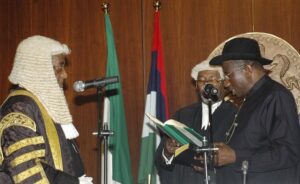
President Jonathan reserves the right to run if he wishes. It is his inalienable right to contest the presidency again. President Tinubu will wholeheartedly welcome him if he decides to enter the race. But Jonathan will have his date in the court of the land. Indeed, the jury will determine whether Jonathan, who was sworn in twice as president, satisfies the constitutional requirements and is eligible to contest the presidency and be sworn in, if successful, for a third term in office, he said.
The key question lies in the interpretation of constitutional provisions regarding term limits and whether Jonathan’s first stint finishing Yar’Adua’s tenure counts as a full term.
Revisiting Jonathan’s Legacy
Onanuga also used the opportunity to revisit Jonathan’s record in office, accusing his administration of economic mismanagement.
We cannot forget in a hurry how his regime, devoid of any clear economic agenda, engaged in frivolous spending, ran the economy aground and put the country in dire straits. The nation’s economic downturn, which President Tinubu is working very hard to overcome, actually began under President Jonathan, he said.
According to him, Jonathan inherited $66 billion in reserves in 2010, comprising $46 billion in foreign reserves and $20 billion in the Excess Crude Account. By 2015, these figures had dwindled drastically.
By 2015, when the people democratically removed him from office, the foreign reserves had fallen below $30 billion, and the Excess Crude Account had been depleted to $2 billion, despite record oil revenue. By December 2014, the Jonathan-led Federal Government could no longer pay salaries to federal civil servants. At least 28 states across the country owed workers huge salary arrears, Onanuga stated.
Tinubu’s Economic Reforms
Contrasting Jonathan’s tenure with the current administration, Onanuga argued that Tinubu’s reforms have helped stabilise the economy and rebuild investor confidence.
In just over two years, President Tinubu has stabilised the economy. GDP grew by 4.23 percent in the second quarter of 2025, the highest in four years. Inflation decreased to 20.12 percent in August 2025, the lowest level in three years. Foreign reserves stand at $42.03 billion, and the naira has virtually stabilised, he said.
Onanuga added that ongoing infrastructure projects and security initiatives demonstrate the government’s commitment to long-term stability and growth.
The PDP and Jerry Gana’s co-travellers broke the economy; President Tinubu is fixing it, he declared.
Broader Implications
The issue of Jonathan’s eligibility is not just a matter of individual ambition but one that touches on Nigeria’s constitutional framework and political future. Analysts suggest that if Jonathan declares for the presidency, the case will likely set a judicial precedent that could reshape interpretations of term limits in Nigeria.
For now, the ball rests in the courts. As the 2027 elections draw closer, political watchers are keenly awaiting whether Jonathan will test the legal waters by formally announcing a return bid.
Whatever the outcome, the debate underscores the tension between Nigeria’s democratic aspirations and the legal frameworks designed to regulate power transitions.